
UX and SEO Unite: Why Google Now Ranks Based on Experience
Search engines no longer reward websites based only on keywords and backlinks — they now evaluate how users experience your site.
User journeys have become a direct ranking signal, shaped by how visitors move through your pages, interact with content, and whether they complete the actions they came for. Google’s algorithm increasingly focuses on what it calls experience-based signals, which include dwell time, bounce rate, scroll behaviour, and task completion.
More than 50% of all web traffic now comes from mobile devices, making mobile responsiveness and site speed critical.
And let’s not forget Core Web Vitals — Google’s measurement of how fast your content loads, how stable the page layout is, and how responsive the site feels. A Largest Contentful Paint (LCP) under 2.5 seconds and a Cumulative Layout Shift (CLS) under 0.1 are now considered essential benchmarks for top rankings.
When SEO meets UX, your site isn’t just discoverable — it’s worth staying on.
UX Signals That Now Influence Rankings
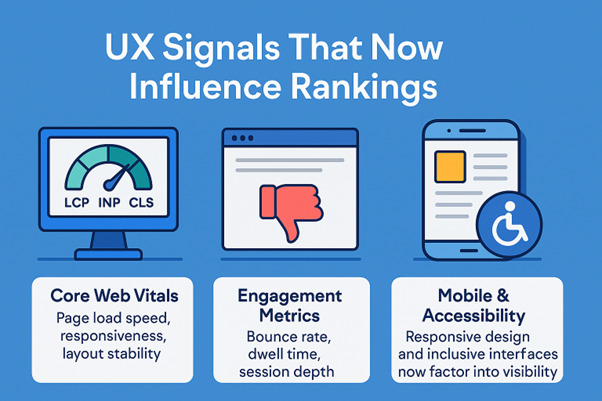
Core Web Vitals: The Technical UX Scorecard
Google’s Core Web Vitals are now among the most important UX signals that influence your rankings. They include three key metrics:
- Largest Contentful Paint (LCP) measures how fast the main content on your page loads — under 2.5 seconds is the current target.
- Interaction to Next Paint (INP) tracks how quickly your site responds when users click or tap — ideally under 200 milliseconds.
- Cumulative Layout Shift (CLS) looks at how visually stable your pages are as they load — a score under 0.1 is considered user-friendly.
These metrics directly reflect how usable your site feels to a visitor.
Engagement Metrics: How Users Behave Tells Google Everything
Search engines watch user behaviour closely. If visitors stay longer (high dwell time), click deeper into your site (session depth), and don’t bounce immediately, these actions indicate relevance and satisfaction.
A bounce rate above 50% could suggest users aren’t getting what they expect and that can harm your rankings.
Mobile & Accessibility: The UX Non-Negotiables
Over half of web users access websites via mobile, so a responsive design isn’t optional anymore it’s expected.
Your content must adapt smoothly across devices, while elements like tap targets, navigation, and font size need to feel native to every screen size.
Equally important, accessibility including screen reader compatibility and keyboard navigation ensures your site meets the expectations of all users, and yes, it influences your visibility too.
How Google Reads User Journeys
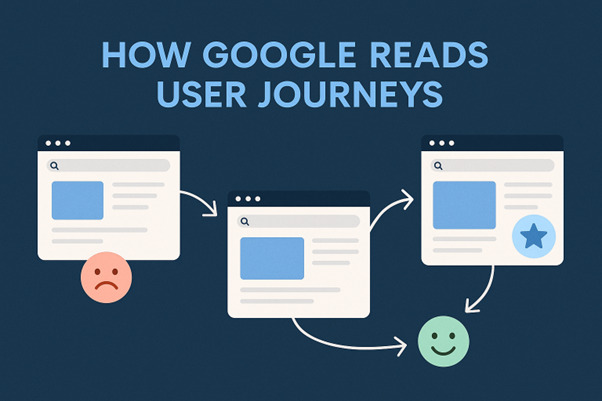
Search Engines Track Every Interaction
When someone lands on your website, Google doesn’t just look at the content it watches what the visitor does next.
Click behaviour, scroll patterns, and how users move from one page to another all help Google understand if the journey is satisfying or frustrating.
Session flow — the sequence in which a user navigates reveals how intuitive and relevant your content truly is.
If a visitor bounces back to the search results within seconds, that’s known as pogo-sticking.
It suggests your page didn’t match their intent, or worse, was confusing or poorly designed. A high volume of these sessions tells Google your site isn’t delivering what users want.
What Good Journeys Look Like to Google
On the other hand, when visitors explore multiple pages, stay longer, or complete actions like filling out forms or clicking CTAs — Google sees that as a positive signal.
This behaviour implies your site is valuable, informative, and engaging. Over time, that consistent engagement can boost your rankings significantly.
Designing for Journey-Based SEO
Start Strong: Match Entry Points to User Intent
Every user lands on your site with a goal. Whether they’re researching, comparing, or ready to convert, your landing page must align with that purpose.
This means your headline, intro, and page structure must clearly show that the visitor is in the right place.
Misaligned pages even with good content can increase bounce rates and kill momentum.
Search intent clarity in the first few seconds makes all the difference.
Guide Seamlessly: Reduce Friction with Intuitive Flow
A great user journey flows like a good conversation natural and easy to follow. Logical menus, a clean layout, and content that unfolds in the right sequence make navigation feel effortless.
Avoid dead ends, clutter, or distractions.
If users need to think too hard, they’ll leave.
Encourage Completion: CTAs That Hit the Right Moment
Call-to-actions are not just buttons, they are nudges placed at moments of peak engagement.
Position them where the user has consumed enough value to take the next step. Whether it’s a booking, enquiry, or download, timing and placement are key to conversions and Google notices.
Tools & Tactics to Measure Journey Signals
Track What Matters, Not Just What’s Visible
Understanding how users move through your site starts with proper tracking. Tools like Google Analytics and Search Console offer key insights into user flow, drop-off points, and navigation paths.
Look closely at pages with high exit rates or short session durations; these are often signs of friction or confusion.
Heatmaps go one step further, showing you exactly where users click, scroll, or stop engaging.
These insights help you see the real story behind each visit.
Validate User Experience with Real Testing
Analytics show patterns, but usability tests reveal why users behave a certain way.
Run focused tests to observe how users interact with forms, navigation, or new page layouts.
Even subtle hesitations or backtracking can expose design flaws or unclear messaging.
Let Data Drive Your UX Fixes
Instead of guessing, optimise your site based on real user behaviour.
Test before launching major changes, then adjust based on what users actually do not what you assume they will.
Final Thoughts
The days of ranking on Google with just keywords and backlinks are long gone. Today, your website’s performance hinges on how well users experience their journey from entry to exit.
Every scroll, click, and second spent on a page sends a message to search engines. When users engage deeply, complete tasks, and navigate smoothly, Google takes notice — and rewards you with visibility.
User journeys are now measurable ranking signals, not just design preferences.
Investing in UX isn’t just about aesthetics it’s about performance, trust, and conversions. From page load speeds and mobile responsiveness to intuitive structure and relevant content, every touchpoint matters.
What’s working behind the scenes is often what drives the biggest results. Test often, refine based on real behaviour, and always aim to meet user intent better than your competitors.
FAQs
User experience affects rankings through engagement signals like bounce rate, session duration, page speed, and mobile responsiveness.
Core Web Vitals are metrics that measure page load speed, visual stability, and interactivity — all crucial for ranking well in Google Search.
Pogo-sticking occurs when users quickly return to search results after clicking a link. It signals to Google that the page didn’t meet their needs.
Yes. A clear layout, fast loading pages, and content that matches search intent help keep users engaged and reduce bounce rate.
Over 50% of traffic comes from mobile. A mobile-friendly site boosts usability and supports Google’s mobile-first indexing for better rankings.